
light surrounds
shines through
glows behind
heads crowned
It’ll guide you
to a safe place
an infinite space
deep inside you
shown true
in forever light
ignited by
an embrace of
the great heights
we aspire to
Tag Archives: Happiness
All Yogic approaches require a commitment to radical self-transformation.

Part 5 of “How do you Qualify Yoga”
While I understand why Georg expounds, Yoga requires a committment to radical self-transformation, I also feel as though it can be stated differently: Yoga requires committment to self-recovery. There is an alchemy to it; but, there is not really anything to transform, you are already who you are seeking. However, our lives, karma, addictions, experiences–whatever you want to call them have veiled the Truth that we are seeking.
About a year ago, I cannot believe this endeavor began a year ago, I wrote a post “Setting it All Down“, in which I shared how my beloved teacher reminded me that the gift of Yoga meditation is setting aside all of the false identities to, hopefully (and with consistency and committment), gain realization of who we truly are.
Sometimes these false identities are so heavy; especially, when life isn’t doing what YOU want, when people aren’t showing up how YOU want, when you realize that in our current incarnation we don’t control– we are part of the karmic wheel– the goal of Yoga being to un-yoke ourselves from this, potentially, never-ending journey.
Yoga is about using every moment in your life to become fully present to what is really going on. To see the only locus of control is your inner environment. It’s not about getting limber on the outside. It’s about limbering up inside.
And, as I mentioned in the posting, “The Practice is Perfect“, you have to do this every day, every minute, every second. And when you slip, you say “Ah, I have something to learn here”.
This has been a time of slipping for me; my life isn’t showing up how I want it to. But, it’s showing up how I, obviously, need it to. Divine consciousness makes no mistakes. So here I go again, maybe one step closer to who I truly am.
A Special Visit

Ooh Formless Divine Mother…. hear my longing, hear my prayers for strength to keep going to use every moment for increasing awareness and to allow the surrendering into formless Love. None of the sensory impressions are me, none of the thoughts are me… ooh take me in Your formless arms, take it all, as I have nothing to loose as none is my. Most deepest gratitude for the sages and the selfless offerings to show us the path… humbly I walk in these golden footprints together with my fellow sadhakas friends, which company I value tremendously. Standing ever stronger for what I know to be true: Aham Brahmasmi ♥ And so are all of you! We are all sparks in the divine ocean of bliss, splashing around but One is true essence. See the Absolute smiling, giving and sharing through the human beings… What a joy to be aware in Vaishvanara! ♥ Have a wonderful day ahead full of play, love and giving ♥
Swami Ma Tripurashakti BharatiWorkshop Registration
This Cartoon Is Going to Become Iconic | Mother Jones
All Yoga Paths Subscribe to Dharma

Part 4 of “How Do You Qualify Yoga”
Please let me forewarn you, this may be a polarizing post. Humans, on many levels, enjoy their misidentification with nonself (to borrow a Buddhist term). We cling desperately to all that we are not–all that we are attached to. The ego is a collection of false identities, which the teachings of Yoga systematically deconstruct. The ego gets particularly obnoxious when we perceive we are being told that we are doing something “incorrectly” (or at least differently from how it was intended).
Dharma is a Sanskrit term which is utilized in many traditions; however, it has no true English translation. Dharma can mean, law, right-way, and order; Feurestein ascribes it to morality. Jainism, Buddhism, Sikhism, and Hinduism are all called “dharmic traditions (or religions)”. Truthfully, there really is no “religion” called Hinduism. Hinduism is a term that originated from the British trying to describe the various traditions of the people Sindhu River. Hinduism is a collection of philosophies, among them: Shaktism, Vaishnavism, and Shaivism–all of whom, like the branches of Yoga, describe the Ultimate Reality in different ways. Sanatana Dharma means the “Eternal Way” (or law, morality, etc.). It is the wellspring out of which the dharmic traditions sprung.
Yoga and Sanatana Dharma cannot be separated. Their lines are intrinsically blurred. While it’s possible to practice Yoga and still adhere to other religious tenets–Christianity is very much a Bhakti Yoga practice–the origins are one and the same. Conversely, it is possible to be a Hindu and not practice Yoga; however, they originate from the same source.
All types of Yoga (not mere asana practice), have a dharmic component. In some paths the tenets are spelled out in recommended actions and restraints. In other paths, there is a call towards looking inward towards ones own moral compass. Regardless, there are no Yogic recommendations towards: competitiveness, hyper-sexuality, greed, or lying. However, that is often the case in the contemporary Yoga scenario. Studios are selling expensive clothing, hyper-mobility is lauded, scant dress is praised, and teacher’s don’t have a personal sadhana. It’s not a judgement, you aren’t bad if you’re doing these things.
Yoga is not about a punitive deity waiting to judge–it’s about becoming so clear and so aligned that you wouldn’t want to do these things. Patanjali calls this the “great vow”. It is not about becoming pious either; but, there is nothing wrong about being aware of what Yoga is and is not.
Brilliant
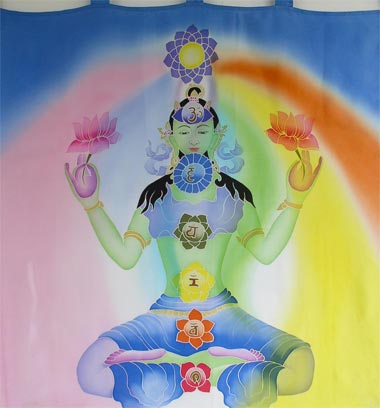
A wind’s blowing
sunlight’s shining
on a river flowing
Silver’s lining
flowers growing.
Chakras aligning
in spirits glowing
Facets combining
in a tender loving
of the all knowing
Cocoon

Look around you
for an abundance
of sigh and terrific proof.
Embrace a refreshing
effervescence in this
moment, arriving whole
and altogether new.
Come alive in pure
love’s transformation
invigorated by a
chosen and heroic truth
Yoga Has Many Branches

Part 3 of “How Do You Qualify Yoga?”
Sorry for the delay in posting this–full-time life happens…
Go back to the bumper sticker I mentioned in post 2 of this series, “I Love Yoga”; we have clarified, ad nauseam, Yoga is the Ecstatic State–Yoga is Union. But, even in philosophical circles, it can also mean the practices and the path that lead to the State. If I asked the driver what type of Yoga they practiced they may say, “I do Power Yoga”, “I do Vinyasa Yoga”, perhaps, “I do Ashtanga Yoga” (that is a whole other posting– Ashtanga classically denotes the eightfold-path of which posture is only one rung), or, “I do Bikram Yoga”. All of these are styles, some debatably more than others, under the umbrella of Hatha Yoga. Let’s park that for a moment and come back to Hatha…
Again, Yoga is a liberation teaching. Unquestionably, the goal of Authentic Yoga is to end the continual cycle of birth and rebirth, to realize the True Self and attain Enlightenment. I know that it’s heavy; but, it’s true.
No how are you going to do that…
The Yogis, in their infinite genius, have devises several avenues to this Penultimate Goal. They are based on your inclinations and where you are in your life. But, the goal of all is the same–YOGA.
According to Georg Feuerstein, and other scholars (there is debate of the number of paths), they are: Karma Yoga, Jnana Yoga, Bhakti Yoga, Tantra Yoga, Mantra Yoga, Hatha Yoga, and Raja Yoga (Authentic Ashtanga Yoga)–I am focusing on the “Hindu” Yoga Pantheon. We can debatably add: Buddhist Yoga and Jain Yoga, too.
I will briefly summarize each path and provide links for further reading. Notice each definition refers to the Ultimate Reality as the Goal. I would at least need to do a full posting to do each one any justice–let’s see what the future holds…
Karma Yoga: A major branch of Yoga, expounded in the first third of the Bhagavad-Gita, is the liberating path of self-transcending action. All actions are given selflessly (seva) with the understanding that all actions come from the Ultimate Reality.
Jnana Yoga: A major branch of Yoga, expounded in the second third of the Bhagavad-Gita, (and numerous other texts, such as the Upanishads) which is based on the cultivation of wisdom as the path to liberation. This wisdom is derived through direct experience of the Ultimate Reality as the Transcendental Self (atman) and through constant discernment of what is real and what is unreal.
Bhakti Yoga: A major branch of Yoga, expounded in the final third of the Bhagavad-Gita, (and numerous other texts, such as the Bhagavata Purana ) is the path of liberation through devotion. Through cultivation of this deep devotion, Bhakti, the seeker connects with the Ultimate Reality as a Supreme Being or Supreme Person.
Karma Yoga: A major branch of Yoga, expounded in the first third of the Bhagavad-Gita, is the liberating path of self-transcending action. All actions are given selflessly (seva) with the understanding that all actions come from the Ultimate Reality.
Tantra Yoga: By far the most complicated branch of traditional Yoga. Tantra focuses on the feminine energy (shakti) as the source of the Ultimate Reality. Broadly speaking Tantra can be broken down into two categories: Left-hand, which uses ritual and deities, and right-hand which is practices internally without ritual and iconography. However, as with many other traditional teachings, Tantra has often been reduced to a mere mockery of itself with focus on increasing sexual prowess.
Mantra Yoga: A major branch of Yoga, which is sometimes grouped as part of Tantra Yoga. This path uses mantras as a path to Ultimate Reality.
Hatha Yoga: A major branch of Yoga, the most renowned in the West, which is sometimes considered to be a part of Tantra. Hatha Yoga was developed by Goraksha and expounded in the Hatha Yoga Pradipika. In the HYP, one-quarter of the text is dedicated to postures (of which only four asana are described), one-quarter to cleansing and breath lengthening (shatkarma and pranayama), one-quarter to seals and locks (mudras and bandhas), and one-quarter to samadhi (the direct experience of Ultimate Reality).
Raja Yoga: A major branch of Yoga, considered to be the most complete methodology of practice. Raja Yoga is also known as Classical Yoga or Ashtanga Yoga (the eightfold path). This classic treatise of this tradition is the timeless Yoga Sutras, codified by Patanjali. The text describes the entire practice and potential experiences of meditation practice. As well as outlines the eightfold path of sadhana: yama, niyama, asana, pranayama, pratyahara, dharana, dhyana, and samadhi–which lead to direct experience of Ultimate Reality.
Despite the many branches the goal is the same. If Ultimate Reality is not the goal, it’s not Yoga. Now what is Ultimate Reality? That’s for the sadhaka to decide… See the chart at the beginning, it’s a question mark…
Love Maker, Earth Mover

The old rule, are you ready to break it?
Convention just isn’t strong enough to make it
It collapses under the weight
of a new world order played out in faith
enlightened by a good man worthwhile
An indigo child running wild
sparkling eyes so sweet, noble to the core
No story quite like this has been written before
He speaks kindly and clearly to every man
He’s a language that everyone understands
He’ll stay with you come whatever may
Staring down the impossible, he always sees a way
So simple yet so profound is his gift
No need to struggle, he’ll lend a hand and just lift
this burden into the ether and off your shoulders
He’ll laugh with you as you grow older
A hero that wants only your favor in return
A fireman to rescue you as this world burns
A great example that equalizes the good books
A man that forces you to take a closer look
at the version of truth you’ve chosen to greet
and if you look both ways before you cross this street
you’ll surely see his gorgeous, speeding karma
blow by brilliantly and run right over your dogma
Yoga Is A Liberation Teaching

Part 2 of “How Do You Qualify Yoga?”
In my previous post, I noted ten points expounded by, the prolific scholar and mystic, Georg Feuerstein on determing “authentic yoga”. I acknowledged these may be controversial; however, they are an interesting platform from which to discuss various aspects of Yoga Philosophy.
Starting out with even the concept of, “Yoga Philosophy”, I often feel fractured. On one hand, I’m thankful to drive around and read all of the bumper stickers which read, ” I Love Yoga”. However, it breaks my heart that most of them are probably unaware that asana and Yoga are not synonymous.
I must backtrack a bit; I have had the great karma to only know Yoga and spirituality to be synonymous. My first encounter with Yoga was as my previous incarnation (in this lifetime) as a devotee of Gurumay Chidvilasananda.
The friends that introduced me to the Siddha Yoga Tradition were sadhakas. Furthermore, in Siddha Yoga asana was presented in the context of being an adjunctive practice.
Ironically, it was my disillusion with Siddha Yoga that brought me into the world of asana as a focus. I left Siddha Yoga because I wanted a personal relationship with my guru– it could not give me that. I explore Sivananda who presented beautiful asana sequences and techniques in the context of Raja Yoga–enlightenment was still the goal. Then, a desire began to arise to know my body more deeply. Asana opened something up that had been blocked. But, my focus moved from knowing the center of consciousness to knowing the center of anna-maya-kosha. I began to study with Iyengar teachers and learn about alignment.
It is important for me to emphasize– this is my experience. It in NOT my critique on the merit or validity of other traditions! Do not read into this what is not there…
This is where my personal Great Schism happened. I went from being a seeker to a posture technician. Although, I have no regrets. I must admit I was distracted. I was allured by the mystique of alignment, angles, and biomechanics. I was fascinated by the improvements my clients experience in their health. All of these are wonderful fringe benefits to a sincere Yoga practice.
Again, I must restate, these are amazing occurrences. But, the goal of Yoga is, as I’ve mentioned in numerous previous posts, is Yoga. Union.
If you still identify with your body, if you still identify with your career path, if you still identify with worldliness, then you have not attained Yoga.
It is not a judgement. It’s not an assessment of worth or value. Its not saying that we are good or bad if we have not attained the state. Most of us haven’t. In fact, many would argue that the reason we’re in a body is because we haven’t attained this state. Or, at least not permanently.
If the goal of your asana practice is to help you meditate so that you can attain Yoga, then the asana is part of sadhana. If its not, then its something else. That’s fine, too. Even the goal of Hatha Yoga is Yoga!
The fact is, Yoga practices are about completely deconstructing our false identities so we are no longer confused about what we are and what we are not. Once we know this, then we can decide what that is. Once we know this, we are no longer chained to the constructs of conventionality. Once we know this, which I stress as being experiential not conceptual, then we are free.
 From the Gross to the Subtle