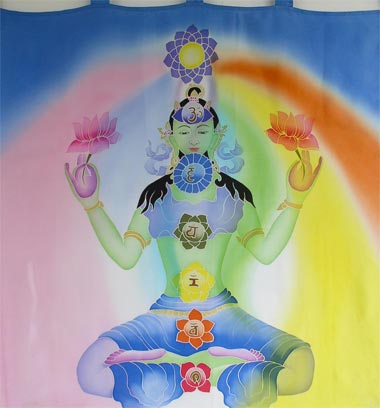
All Yogic approaches require the implementation of Discipline and Detachment.

Part 7 of “How Do You Qualify Yoga?

People think that sadhana–the yogic path–means the day-to-day process.  In a way it does, it is what practices you do (meditation, breath work, etc).  But, abhyasa is the moment to moment committment to this way of being and living.  It’s the cultivation, not obsession, of remembering your committment to reach Yoga.  But, all of the work you do has to be done with surrender–if you expect an exact outcome you are living in the world of control.  Control is an illusion.  There are many factors affecting us at any given time; our karma is coiled and spiraled in ways we cannot imagine.  So we do the work, we commit to the path, and we let go.  We make mistakes and we try again.  Life throws curve balls and we still meditate, contemplate, pray, and offer gratitude.  We are not bargaining with the Center of Consciousness– we are trying to connect to it.  Although, the irony is, we are never away from it.  Let the trials help you remember that every moment is Holy and Divine.

From Swami Jnaneshvara Bharati

The Silence

enjoy_the_silence_by_archnophobia

From the Gross to the Subtle is proud to present our third guest blogger: the esteemed Cecelia Smith.  Please contact us if you would like to share lesson, personal experiences, meditations, and poetry from dharmic traditions and mindfulness.  Thank you for blessing us Cecelia.

THE SILENCE

Silence is of inestimable value in creating the place of change we are destined to inhabit. As our silence grows, so does the attributes of the One Being into whom we are transforming ourselves. Most of us are not yet capable of being in the Silence for extended periods of time. That is as it should be at this point in our development. Although, we may meditate for long periods of time, our moments of true Silence are very brief. Every second of linear time spent in true Silence is vast in the change it brings and the momentum it builds in our ongoing expansion. Each second of true Silence adds to our store of Silence and makes it easier for us to achieve that ultimate Silence in which we know ourselves as One Being.

That point, that second of transforming Silence is very close, and gets closer with every brush we make with the Silence. We feel it as a tremor, an awesomeness surrounding everything we do. We become excited in our anticipation of the revelations of ourselves, the One Being, Humanity. This excitement shatters our individual Silence, but in no way touches or disturbs the collective Silence we augmented by our entrance of the Silence. Second by second it grows. Second, by second, we are drawn closer to our objective; second by silent second we are a little more awake. The split second which transforms separate ego based individuals into the Great Being of Humanity is so very close. It is said in sacred writings that “no one knows the minute, or the hour when the Son of Man comes.” That is the truth.

We are building the habitation for the Son of Man on a second by silent second basis. The excitement is almost unbearable. The suspense so great, that some of us rush ahead. The Son is not ahead. The Son is not behind. The Son (translated SUN) is within the silent seconds we spend in the Silence. The magnificence of the raising Sun draws strength and substance within the Silence, getting bolder with every second spent within it. This Silence is an act of grace. We pray, we meditate, we sing, we dance, we expect and we love, all doing all building, all calling for the Silence to overtake us. Then it does and we remember. The truth of who we are dawns within our consciousness. We are astonished by our beauty and grandeur. Then we retreat from the Silence enter the world of doing again, leaving behind a Silence grown larger by our silent presence. The birthing of the Sun of man draws ever more close.

Enter The Silence Now and Become the Sun.

” I have written almost all my life. I write because I must. Words pile up inside my head and the only outlet for me to have is to write. I choose to share some of these writings in my blog ‘motivated in spirit” to inspire first myself and then others. It is my hope and prayer that you find these blogged words inspirational. Thank you… In the deepest love, Cecelia”

Cecelia’s home blog is:

Motivated By Spirit

A motivational blog to remind ourselves of our grandeur and Divinity.

http://motivatedinspirit.blogspot.com/


Yoga is a Continuum of Theory and Practice

10268564_10202737097364294_1479620227992725011_n

Part 6 of “How do you Qualify Yoga?”; this should have been Part 5. I accidentally skipped a section… Oops

We will, ultimately, put this whole series on its own page in the menu bar. In addition to guest contributors, we’ll be moving older post into pages that can more easily be accessed for future reading.

This is probably my favorite post in this series. It reminds me of a quote I learned almost twenty years ago, when I was a member of Siddha Yoga, “Muktananda, put down the book and meditate”.

We live in an amazing time where information is accessible instantaneously. If you’re like me, attachments are a real issue, a hindrance as the Buddhist described them, even attachment to more “knowledge”. I can easily find myself listening to an audiobook during my commute, taking numerous workshops, and trying out new techniques.

It’s not that this is wrong–it’s simply that it is, according to Ma Tri, “mere knowledge”.  Furthermore, the quest for acquisition is insatiable–whether it is material or intellectual.

According to the Yoga Sutra 1.7, there are three ways of gathering correct knowledge, “…there are three ways of gaining correct knowledge (pramana): 1) perception, 2) inference, and 3) testimony or verbal communication from others who have knowledge”.

Swami J goes further to explain, “…you should not believe what you hear, but should seek direct experience… The second part is that of reasoning, whereby you want that experience to be understood in the light of your own inference or reasoning. The third part is that you seek the validation through some respected authority or testimony [scripture]… When you can get these three to converge, meaning that experience, reasoning, and authoritative validation all agree with one another, then you know, and you know that you know…”

Swami J draws a metaphor of Yoga Meditation and mastery of an instrument.  A virtuoso knows the technique and theory; but, the also play from the heart.

My teacher will often appear cryptic when I ask a question, recently, when I was perplexed he said, “You’ll find it in the light of Atman”.  In other words, I needed to go inside–I am the one I am seeking after all.

Swami Rama described us scientists and encouraged us to “experiment” on ourselves.

The Buddha famously explained, his path was working for him.  But, if it doesn’t work for you, don’t do it.

But, how will you know if you don’t go inside–often?

Ripples and Tsunamis

11059693_499535620202889_4590136049900749382_n
I saw the quote above on PDAN Teen.  The I rememebred, Ma Tri once described thoughts as ripples on the lake of the mind. She went on further to described emotions as Tsunamis. Then she expounded, “Imagine you could harness the energy of a Tsunami. Imagine if you directed that to whatever your life’s goal is”.  It left me speechless. I long to crave self-realization with the same fervor as any other Tsunami which has roared through me. Until then, I’ll ride the waves and learn to surf.

All Yogic approaches require a commitment to radical self-transformation.

Part 5 of “How do you Qualify Yoga

While I understand why Georg expounds, Yoga requires a committment to radical self-transformation, I also feel as though it can be stated differently: Yoga requires committment to self-recovery.  There is an alchemy to it; but, there is not really anything to transform, you are already who you are seeking.  However, our lives, karma, addictions, experiences–whatever you want to call them have veiled the Truth that we are seeking.

About a year ago, I cannot believe this endeavor began a year ago, I wrote a post “Setting it All Down“, in which I shared how my beloved teacher reminded me that the gift of Yoga meditation is setting aside all of the false identities to, hopefully (and with consistency and committment), gain realization of who we truly are.

Sometimes these false identities are so heavy; especially, when life isn’t doing what YOU want, when people aren’t showing up how YOU want, when you realize that in our current incarnation we don’t control– we are part of the karmic wheel– the goal of Yoga being to un-yoke ourselves from this, potentially, never-ending journey.

Yoga is about using every moment in your life to become fully present to what is really going on.  To see the only locus of control is your inner environment.  It’s not about getting limber on the outside.  It’s about limbering up inside.

And, as I mentioned in the posting, “The Practice is Perfect“, you have to do this every day, every minute, every second.  And when you slip, you say “Ah, I have something to learn here”.

This has been a time of slipping for me; my life isn’t showing up how I want it to.  But, it’s showing up how I, obviously, need it to.  Divine consciousness makes no mistakes.  So here I go again, maybe one step closer to who I truly am.

This Cartoon Is Going to Become Iconic | Mother Jones

http://m.motherjones.com/contributor/2015/06/the-gays-won-the-civil-war

All Yoga Paths Subscribe to Dharma

images

Part 4 of “How Do You Qualify Yoga

Please let me forewarn you, this may be a polarizing post.  Humans, on many levels, enjoy their misidentification with nonself (to borrow a Buddhist term).  We cling desperately to all that we are not–all that we are attached to.  The ego is a collection of false identities, which the teachings of Yoga systematically deconstruct.  The ego gets particularly obnoxious when we perceive we are being told that we are doing something “incorrectly” (or at least differently from how it was intended).

Dharma is a Sanskrit term which is utilized in many traditions; however, it has no true English translation.  Dharma can mean, law, right-way, and order; Feurestein ascribes it to morality.  Jainism, Buddhism, Sikhism, and Hinduism are all called “dharmic traditions (or religions)”.  Truthfully, there really is no “religion” called Hinduism.  Hinduism is a term that originated from the British trying to describe the various traditions of the people Sindhu River.  Hinduism is a collection of philosophies, among them: Shaktism, Vaishnavism, and Shaivism–all of whom, like the branches of Yoga, describe the Ultimate Reality in different ways.  Sanatana Dharma means the “Eternal Way” (or law, morality, etc.).  It is the wellspring out of which the dharmic traditions sprung.

Yoga and Sanatana Dharma cannot be separated.  Their lines are intrinsically blurred.  While it’s possible to practice Yoga and still adhere to other religious tenets–Christianity is very much a Bhakti Yoga practice–the origins are one and the same. Conversely, it is possible to be a Hindu and not practice Yoga; however, they originate from the same source.

All types of Yoga (not mere asana practice), have a dharmic component.  In some paths the tenets are spelled out in recommended actions and restraints.  In other paths, there is a call towards looking inward towards ones own moral compass.  Regardless, there are no Yogic recommendations towards: competitiveness, hyper-sexuality, greed, or lying.  However, that is often the case in the contemporary Yoga scenario.  Studios are selling expensive clothing, hyper-mobility is lauded, scant dress is praised, and teacher’s don’t have a personal sadhana.  It’s not a judgement, you aren’t bad if you’re doing these things.

Yoga is not about a punitive deity waiting to judge–it’s about becoming so clear and so aligned that you wouldn’t want to do these things.  Patanjali calls this the “great vow”.  It is not about becoming pious either; but, there is nothing wrong about being aware of what Yoga is and is not.

Brilliant

SK1_SilkChakra_Wallhanging

A wind’s blowing
sunlight’s shining
on a river flowing
Silver’s lining
flowers growing.
Chakras aligning
in spirits glowing
Facets combining
in a tender loving
of the all knowing

Cocoon

butterfly-cocoon-6

Look around you
for an abundance
of sigh and terrific proof.
Embrace a refreshing
effervescence in this
moment, arriving whole
and altogether new.
Come alive in pure
love’s transformation
invigorated by a
chosen and heroic truth

Yoga Has Many Branches

circle-chart-small-YELLOW-WDDS

Part 3 of “How Do You Qualify Yoga?”

Sorry for the delay in posting this–full-time life happens…

Go back to the bumper sticker I mentioned in post 2 of this series, “I Love Yoga”; we have clarified, ad nauseam, Yoga is the Ecstatic State–Yoga is Union.  But, even in philosophical circles, it can also mean the practices and the path that lead to the State.  If I asked the driver what type of Yoga they practiced they may say, “I do Power Yoga”, “I do Vinyasa Yoga”, perhaps, “I do Ashtanga Yoga” (that is a whole other posting– Ashtanga classically denotes the eightfold-path of which posture is only one rung), or, “I do Bikram Yoga”.  All of these are styles, some debatably more than others, under the umbrella of Hatha Yoga.  Let’s park that for a moment and come back to Hatha…

Again, Yoga is a liberation teaching.  Unquestionably, the goal of Authentic Yoga is to end the continual cycle of birth and rebirth, to realize the True Self and attain Enlightenment.  I know that it’s heavy; but, it’s true.

No how are you going to do that…

The Yogis, in their infinite genius, have devises several avenues to this Penultimate Goal.  They are based on your inclinations and where you are in your life.  But, the goal of all is the same–YOGA.

According to Georg Feuerstein, and other scholars (there is debate of the number of paths), they are: Karma Yoga, Jnana Yoga, Bhakti Yoga, Tantra Yoga, Mantra Yoga, Hatha Yoga, and Raja Yoga (Authentic Ashtanga Yoga)–I am focusing on the “Hindu” Yoga Pantheon.  We can debatably add: Buddhist Yoga and Jain Yoga, too.

I will briefly summarize each path and provide links for further reading.  Notice each definition refers to the Ultimate Reality as the Goal.  I would at least need to do a full posting to do each one any justice–let’s see what the future holds…

Karma Yoga: A major branch of Yoga, expounded in the first third of the Bhagavad-Gita, is the liberating path of self-transcending action. All actions are given selflessly (seva) with the understanding that all actions come from the Ultimate Reality.

Jnana Yoga: A major branch of Yoga, expounded in the second third of the Bhagavad-Gita, (and numerous other texts, such as the Upanishads) which is based on the cultivation of wisdom as the path to liberation.  This wisdom is derived through direct experience of the Ultimate Reality as the Transcendental Self (atman) and  through constant discernment of what is real and what is unreal.

Bhakti Yoga: A major branch of Yoga, expounded in the final third of the Bhagavad-Gita, (and numerous other texts, such as the Bhagavata Purana ) is the path of liberation through devotion.   Through cultivation of this deep devotion, Bhakti, the seeker connects with the Ultimate Reality as a Supreme Being or Supreme Person.

Karma Yoga: A major branch of Yoga, expounded in the first third of the Bhagavad-Gita, is the liberating path of self-transcending action. All actions are given selflessly (seva) with the understanding that all actions come from the Ultimate Reality.

Tantra Yoga: By far the most complicated branch of traditional Yoga.  Tantra focuses on the feminine energy (shakti) as the source of the Ultimate Reality.  Broadly speaking Tantra can be broken down into two categories: Left-hand, which uses ritual and deities, and right-hand which is practices internally without ritual and iconography.  However, as with many other traditional teachings, Tantra has often been reduced to a mere mockery of itself with focus on increasing sexual prowess.

Mantra Yoga: A major branch of Yoga, which is sometimes grouped as part of Tantra Yoga.  This path uses mantras as a path to Ultimate Reality.

Hatha Yoga: A major branch of Yoga, the most renowned in the West, which is sometimes considered to be a part of Tantra. Hatha Yoga was developed by Goraksha and expounded in the Hatha Yoga Pradipika.  In the HYP, one-quarter of the text is dedicated to postures (of which only four asana are described), one-quarter to cleansing and breath lengthening (shatkarma and pranayama), one-quarter to seals and locks (mudras and bandhas), and one-quarter to samadhi (the direct experience of Ultimate Reality).  

Raja Yoga: A major branch of Yoga, considered to be the most complete methodology of practice.  Raja Yoga is also known as Classical Yoga or Ashtanga Yoga (the eightfold path).  This classic treatise of this tradition is the timeless Yoga Sutras, codified by Patanjali.  The text describes the entire practice and potential experiences of meditation practice.  As well as outlines the eightfold path of sadhana: yama, niyama, asana, pranayama, pratyahara, dharana, dhyana, and samadhi–which lead to direct experience of Ultimate Reality.

Despite the many branches the goal is the same.  If Ultimate Reality is not the goal, it’s not Yoga.  Now what is Ultimate Reality?  That’s for the sadhaka to decide… See the chart at the beginning, it’s a question mark…