Grace and Discipline a Two-handed Embrace

This post will also be on the Abundant Earth Coop online zine: https://abundantearthcooperative.com/

It’s so good to be back…

As a spiritual leader, minister, and teacher, I am struck by how often people will quickly say they are “spiritual but not religious.” While I can understand the desire to avoid being pigeonholed by institutionalized and dogmatic traditions, I also feel there can be a wishy-washy quality to calling oneself spiritual and not having a set practice to support the spiritual claim. I have found that discipline is an essential component of most spiritual practices, but discipline can also be cold and stringent. Ironically, in my own experience, if I don’t stay consistent with my goal of a particular practice schedule, I may swing my pendulum entirely in the opposite direction and almost rebel by not doing any kind of practice. As I considered why I had hit this confusing ‘back and forth’ roadblock, I realized I needed to balance grace and discipline. 

As for grace, I think of it in two forms. The first is Grace with a big ‘G’, (aka Divine Grace) which flows from the center of consciousness to all sentient beings. It is the Grace we might perceive as a guardian angel, and it is the situations and skills present that pull us back into our highest selves. This Grace is constantly flowing; we fall into it when we surrender. The other form is grace with a little ‘g’. It is a microcosmic version of Divine Grace. It shows up as self-compassion for our shortcomings, patience with our inconsistencies, striving, slipping, and beginning again, and discipline is of utmost importance to support that grace from within. When we focus on self-grace, we can temper the edginess of discipline.

To work with discipline, it is essential to have structure. I have been experimenting with ways to create optimal time for gratitude and meditation. Since I am a morning person, I have found that my mood and awareness of the silent stillness within are maintained when I start my day with prayer, meditation, and gratitude. It could be a challenge for me to create a consistent routine since I have an atypical schedule where my morning obligations change from week to week. Rather than allow this to be a roadblock, I have become creative with my morning rituals. I do an abridged practice in the weeks that I have an earlier commitment, and in the weeks when my commitments start later, I do a more extensive practice. Regardless of my circumstances, I begin my day by attuning myself to the highest version of Source. Some days I have to shorten my practice even further, but instead of skipping my practice on those days, I give myself at least two to three minutes to remember my purpose. I also give myself grace for extenuating circumstances such as needing to adjust for children, work, and traffic. Despite these real situations, I do something every day. 

Self-grace acknowledges that I am not a monk; I’m a mother, and I live in the world. However, I don’t allow this to turn into excuses and lapse into behaviors that pull me away from awareness of the Divine. We are in the Divine; we are the Divine. The Divine is constantly pulling to help us realign and connect with that which gets covered by our everyday busyness. In the same way, Divine Grace constantly flows to us, and we can benefit from giving ourselves the same grace that the Divine is always giving us. It’s helpful to lovingly remind ourselves we are doing our best in any given moment, that we will only grow when we choose to attempt consistency in our spiritual work, and that it is ok to start over when we falter. The best results come when spirituality is not merely a hobby but when it becomes a lifestyle.

There Is No Spoon

spoon4

Every moment is the only moment.  In the midst of tragedy you can choose to go into the Self and find the Eternal Truth.  This is untainted by the transient, and often troubled, world.  Despite what appears to be chaos, there is a substratum where we all are One.  Through meditation on silence and affirmative prayer we connect with this Divine Matrix.  Then you realize, like in the movie, that you don’t have to try to bend spoons.

There are always atrocities on the news.  Anyone of average intelligence knows that sensationalism sells.  But, for me, it feels so close to home right now.  This body I have incarnated in is Black and I am raising children how have incarnated as mixed-race people.  Yes, I deeply believe (and in moments of samadhi I have known) that and we are all One.  Yet, when I open my eyes and engage in the world I, temporarily, forget.

I become angry and I fear for my son–who is the sweetest young man I know.  He is 6′ 2″ at age fourteen.  I plead with him to not wear his hood, to be polite, and not to cut through the neighbor’s yard–because he may be murdered.  Yes, I am deeply committed to my spiritual practices and I know that no one dies.  But, our karmic bond is deeper than philosophical conjecture.

I’m playing multiple roles on the stage we call “life”.  Some of the roles seem to contradict each other.  As a mother, I am a wildcat backed into a corner who is desperately trying to care for her cubs.   As a an aspirant, I uphold the tenet that all life is equal and valuable.  I also strive to remember that those who inciting violence are in pain.  But, sometimes it easier said than done.

Two wise teachers told me, there are two things we always must remember.  First:

Everything is the opposite of what it appears to be and nothing is the opposite of what it appears to be.

Second:

Anything you do everything you experience will either bring you closer to or farther from the Truth (Center of Consciousness, perception of God, Yoga, Unity, Christ Consciousness, and numerous names for Supreme Oneness).

The first principle is that we really never know what is going on beneath the surface level of appearances.  I mentioned, perpetrators of violence are victims, as well.  Karma is intertwined at every level.  What we are seeing is a ripple on the surface of the ocean of cause and effect.  It’s not judgement by an anthropomorphic paternal deity– we are seeing the ripples from infinite stones being thrown into the lake of eternity.

The second principle is to cease throwing stones which cloud the lake and obscure the Truth.  The second principle is supreme compassion for ourselves–at any given moment we can choose to love everyone.  At any moment we can look at someone and choose to remember there is no other.  These are choices made in a nanosecond.

Then we bend, we grow, we advance and we can be a beacon to bring those who are still perceiving separation toward Our Collective Center of Consciousness.

Part 1 of 30 Days of Peace…

Mind, Please be My Friend…

image

When the modifications of the mind have become weakened, the mind becomes a transparent crystal…

Sutra 1.4

I originally posted this a year ago. This posting is extremely close to my heart. I’m always seeking a friendship with my heart and mind.

The last few weeks have been fairly hectic: I am planning a meditation intensive retreat, I am taking some continuing education classes, my work schedule is changing, the children have a bunch of activities, and I am a little over-extended.  So working on a blog post has been demoted on my list of obligations.

But, despite all the busyness, my mind-state has been fairly steady, or ekagra.  I attribute this to regularity in my practice.

In the Yoga Tradition, the mind is viewed as an instrument through which we receive information about the sensory world (manas), where we store memories and formulate opinions (chitta), it is where our sense of individuality arises (ahamkara), and where our conscience resides (buddhi)–but, not our consciousness.

The four aforementioned aspects of the mind are collectively called the antahkarana–or the inner instrument.  The word “instrument” is so profound.  Yoga science expounds, the mind is not who we are; but, mind is a tool, which can be sharpened to glean clearer understanding of who we are and what needs to be done to Realize our True Nature.

According to Yoga science, our minds becomes colored by our experiences— think of it as a dusty layer on a window.  Therefore, they do not allow the truth to diffuse through. We are colored by perceptions of race, social status, gender, etc.  Reflect for a moment on a baby who lacks these associations.

Through meditation we wipe off the layers of dust and eventually the clear mind allows the truth to shine through.

But, the mind is only capable of becoming crystalline… 

What is the light that shines through the crystalline mind?

Eventually, the mind, like all good tools must be set down.  Would you walk around in the house you built clutching the hammer?

Over time, with dedication, consistency, and faith, the mind is set down and total awareness of the Self will shine through.

Until then, tell your mind “thank-you” for all that it does.  Do not be angry with your mind for thinking any more than you would be angry with your hand for grasping or your ear for hearing.  Ask your mind to be your friend, so that you can dust the lens, and see the world as it truly is.

As always, click the links!

All Yogic approaches require the implementation of Discipline and Detachment.

Part 7 of “How Do You Qualify Yoga?

People think that sadhana–the yogic path–means the day-to-day process.  In a way it does, it is what practices you do (meditation, breath work, etc).  But, abhyasa is the moment to moment committment to this way of being and living.  It’s the cultivation, not obsession, of remembering your committment to reach Yoga.  But, all of the work you do has to be done with surrender–if you expect an exact outcome you are living in the world of control.  Control is an illusion.  There are many factors affecting us at any given time; our karma is coiled and spiraled in ways we cannot imagine.  So we do the work, we commit to the path, and we let go.  We make mistakes and we try again.  Life throws curve balls and we still meditate, contemplate, pray, and offer gratitude.  We are not bargaining with the Center of Consciousness– we are trying to connect to it.  Although, the irony is, we are never away from it.  Let the trials help you remember that every moment is Holy and Divine.

From Swami Jnaneshvara Bharati

All Yoga Paths Subscribe to Dharma

images

Part 4 of “How Do You Qualify Yoga

Please let me forewarn you, this may be a polarizing post.  Humans, on many levels, enjoy their misidentification with nonself (to borrow a Buddhist term).  We cling desperately to all that we are not–all that we are attached to.  The ego is a collection of false identities, which the teachings of Yoga systematically deconstruct.  The ego gets particularly obnoxious when we perceive we are being told that we are doing something “incorrectly” (or at least differently from how it was intended).

Dharma is a Sanskrit term which is utilized in many traditions; however, it has no true English translation.  Dharma can mean, law, right-way, and order; Feurestein ascribes it to morality.  Jainism, Buddhism, Sikhism, and Hinduism are all called “dharmic traditions (or religions)”.  Truthfully, there really is no “religion” called Hinduism.  Hinduism is a term that originated from the British trying to describe the various traditions of the people Sindhu River.  Hinduism is a collection of philosophies, among them: Shaktism, Vaishnavism, and Shaivism–all of whom, like the branches of Yoga, describe the Ultimate Reality in different ways.  Sanatana Dharma means the “Eternal Way” (or law, morality, etc.).  It is the wellspring out of which the dharmic traditions sprung.

Yoga and Sanatana Dharma cannot be separated.  Their lines are intrinsically blurred.  While it’s possible to practice Yoga and still adhere to other religious tenets–Christianity is very much a Bhakti Yoga practice–the origins are one and the same. Conversely, it is possible to be a Hindu and not practice Yoga; however, they originate from the same source.

All types of Yoga (not mere asana practice), have a dharmic component.  In some paths the tenets are spelled out in recommended actions and restraints.  In other paths, there is a call towards looking inward towards ones own moral compass.  Regardless, there are no Yogic recommendations towards: competitiveness, hyper-sexuality, greed, or lying.  However, that is often the case in the contemporary Yoga scenario.  Studios are selling expensive clothing, hyper-mobility is lauded, scant dress is praised, and teacher’s don’t have a personal sadhana.  It’s not a judgement, you aren’t bad if you’re doing these things.

Yoga is not about a punitive deity waiting to judge–it’s about becoming so clear and so aligned that you wouldn’t want to do these things.  Patanjali calls this the “great vow”.  It is not about becoming pious either; but, there is nothing wrong about being aware of what Yoga is and is not.

Brilliant

SK1_SilkChakra_Wallhanging

A wind’s blowing
sunlight’s shining
on a river flowing
Silver’s lining
flowers growing.
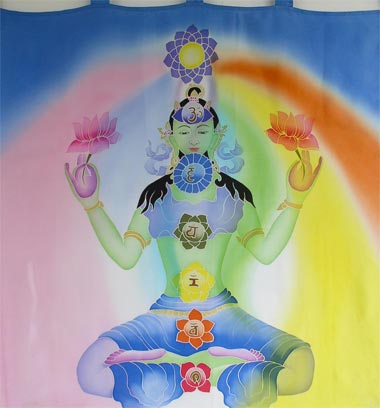
Chakras aligning
in spirits glowing
Facets combining
in a tender loving
of the all knowing

Yoga Has Many Branches

circle-chart-small-YELLOW-WDDS

Part 3 of “How Do You Qualify Yoga?”

Sorry for the delay in posting this–full-time life happens…

Go back to the bumper sticker I mentioned in post 2 of this series, “I Love Yoga”; we have clarified, ad nauseam, Yoga is the Ecstatic State–Yoga is Union.  But, even in philosophical circles, it can also mean the practices and the path that lead to the State.  If I asked the driver what type of Yoga they practiced they may say, “I do Power Yoga”, “I do Vinyasa Yoga”, perhaps, “I do Ashtanga Yoga” (that is a whole other posting– Ashtanga classically denotes the eightfold-path of which posture is only one rung), or, “I do Bikram Yoga”.  All of these are styles, some debatably more than others, under the umbrella of Hatha Yoga.  Let’s park that for a moment and come back to Hatha…

Again, Yoga is a liberation teaching.  Unquestionably, the goal of Authentic Yoga is to end the continual cycle of birth and rebirth, to realize the True Self and attain Enlightenment.  I know that it’s heavy; but, it’s true.

No how are you going to do that…

The Yogis, in their infinite genius, have devises several avenues to this Penultimate Goal.  They are based on your inclinations and where you are in your life.  But, the goal of all is the same–YOGA.

According to Georg Feuerstein, and other scholars (there is debate of the number of paths), they are: Karma Yoga, Jnana Yoga, Bhakti Yoga, Tantra Yoga, Mantra Yoga, Hatha Yoga, and Raja Yoga (Authentic Ashtanga Yoga)–I am focusing on the “Hindu” Yoga Pantheon.  We can debatably add: Buddhist Yoga and Jain Yoga, too.

I will briefly summarize each path and provide links for further reading.  Notice each definition refers to the Ultimate Reality as the Goal.  I would at least need to do a full posting to do each one any justice–let’s see what the future holds…

Karma Yoga: A major branch of Yoga, expounded in the first third of the Bhagavad-Gita, is the liberating path of self-transcending action. All actions are given selflessly (seva) with the understanding that all actions come from the Ultimate Reality.

Jnana Yoga: A major branch of Yoga, expounded in the second third of the Bhagavad-Gita, (and numerous other texts, such as the Upanishads) which is based on the cultivation of wisdom as the path to liberation.  This wisdom is derived through direct experience of the Ultimate Reality as the Transcendental Self (atman) and  through constant discernment of what is real and what is unreal.

Bhakti Yoga: A major branch of Yoga, expounded in the final third of the Bhagavad-Gita, (and numerous other texts, such as the Bhagavata Purana ) is the path of liberation through devotion.   Through cultivation of this deep devotion, Bhakti, the seeker connects with the Ultimate Reality as a Supreme Being or Supreme Person.

Karma Yoga: A major branch of Yoga, expounded in the first third of the Bhagavad-Gita, is the liberating path of self-transcending action. All actions are given selflessly (seva) with the understanding that all actions come from the Ultimate Reality.

Tantra Yoga: By far the most complicated branch of traditional Yoga.  Tantra focuses on the feminine energy (shakti) as the source of the Ultimate Reality.  Broadly speaking Tantra can be broken down into two categories: Left-hand, which uses ritual and deities, and right-hand which is practices internally without ritual and iconography.  However, as with many other traditional teachings, Tantra has often been reduced to a mere mockery of itself with focus on increasing sexual prowess.

Mantra Yoga: A major branch of Yoga, which is sometimes grouped as part of Tantra Yoga.  This path uses mantras as a path to Ultimate Reality.

Hatha Yoga: A major branch of Yoga, the most renowned in the West, which is sometimes considered to be a part of Tantra. Hatha Yoga was developed by Goraksha and expounded in the Hatha Yoga Pradipika.  In the HYP, one-quarter of the text is dedicated to postures (of which only four asana are described), one-quarter to cleansing and breath lengthening (shatkarma and pranayama), one-quarter to seals and locks (mudras and bandhas), and one-quarter to samadhi (the direct experience of Ultimate Reality).  

Raja Yoga: A major branch of Yoga, considered to be the most complete methodology of practice.  Raja Yoga is also known as Classical Yoga or Ashtanga Yoga (the eightfold path).  This classic treatise of this tradition is the timeless Yoga Sutras, codified by Patanjali.  The text describes the entire practice and potential experiences of meditation practice.  As well as outlines the eightfold path of sadhana: yama, niyama, asana, pranayama, pratyahara, dharana, dhyana, and samadhi–which lead to direct experience of Ultimate Reality.

Despite the many branches the goal is the same.  If Ultimate Reality is not the goal, it’s not Yoga.  Now what is Ultimate Reality?  That’s for the sadhaka to decide… See the chart at the beginning, it’s a question mark…

How Do You Qualify Yoga?

om-symbol-24473227

It’s been awhile since I last posted.  I am so grateful to Chad for holding down the fort with his amazing poetry.  If you didn’t get a chance to read his evocative piece, “Aghori” you should definitely do so!  If you are not familiar with that name, the Aghori are an obscure Tantric sect from India who engage in unconventional practices to bring them union with The Center of Consciousness.  I have to admit, even finding a great link to share on them was nearly impossible.  Most pages are super-sensationalized and prejudiced.

I first learned about the Aghori from, the late German-Canadian Yoga Historian and Philosopher, Georg Feuerstein.  His in depth, and provocative, work, “Tantra“, demystifies the various aspects of the, often misunderstood, aforementioned philosophy.

This morning, on my way to work, I was listening to another Feuerstein pearl, “The Lost Teachings of Yoga“–even his voice is mesmerizing.  Georg elucidates ten points that demark “Authentic Yoga”.  Now, whether or not you agree with this list, he provides poignant arguments.  Additionally, we (myself, obviously, included) can find our feathers ruffled by the Truth.  Perhaps, if these points cause disequilibrium, like Piaget, you can consider them opportunities for growth.

1. Yoga is a Liberation Teaching.

2. Yoga has many branches.

3. All Yoga paths subscribe to Dharma.

4. Yoga is a continuum of theory and practice.

5. All Yogic approaches require a commitment to radical self-transformation.

6. All Yogic approaches require the implementation of discipline and detachment.

7. The closer we come to Enlightenment the more ordinary we become.

8. All Yogic approaches account for surprise and/or grace.

9. All Yogic approaches are initiatory.

10. All Yogic approaches involve the replacement of old habit patterns with new benign patterns.

I will begin a series of 10 posts based on each of Georg’s posits.  I hope you enjoy them.

Om Shanti Namasté
ओम शांति नमस

Aghori

aghori-baba-long-hairs

Raw potential
is a wild darkness
boiling with light.
Consciousness arose
from profound
processes, existential
its purpose,
to give us eyes
to see divinity
even in the
blackest night.

Nativity

tree-roots-silhouette-18580002

Mother roots are vessels
deep in the Earth.
Trees leisurely bleed into sky
when they give birth.