The Pinnacle of the Three Streams

The Three Streams

Sometimes you learn a technique, teaching, or explanation that cannot be trumped.  I was on Facebook reading a fellow teachers notes and they reminded me of Swami Jnaneshvara’s succinct cumulative definition of Yoga.  Since it is not something that can be intellectualized, this definition is comprised of a few ways to gain a mote of “comprehension” of something that is purely experiential.  I have added links to every one of the Sanskrit terms.  Learning these relationships is a great asset in the development of a Yoga Meditation practice.  Thank you, Swami J, for your compilation.  (The full text from which this definition is drawn can be found here)

Traditionally, Yoga (Sanskrit: union) has referred to the realization through direct experience of the preexisting union between the microcosm of individuality and the macrocosm of universality, Atman and Brahman, Jivatman and Paramatman, and Shiva and Shakti, or the realization of Purusha standing alone as separate from Prakriti.

Yoga is the union of the

– Microcosm of individuality and the

– Macrocosm of universality

Yoga is the union of

Prana vayu (the upward flowing prana) and

– Apana vayu (the downward flowing prana)

Yoga is the union of

Atman (Center of consciousness, Self; Vedanta) and

– Brahman (Absolute reality; Vedanta)

Yoga is the union of

Jivatman (Soul as consciousness plus traits; Vedanta) and

– Paramatman: (Self/soul as only consciousness; Vedanta)

Yoga is the union of

Shiva (Static, latent, unchanging, masculine; Tantra) and

– Shakti (Active, manifesting, changing, feminine; Tantra)

Yoga is the dis-union of

Purusha (Untainted consciousness; Sankyha-Yoga) and

– Prakriti (Primordial, unmanifest matter; Sankyha-Yoga)
 

Journey to the New AGE

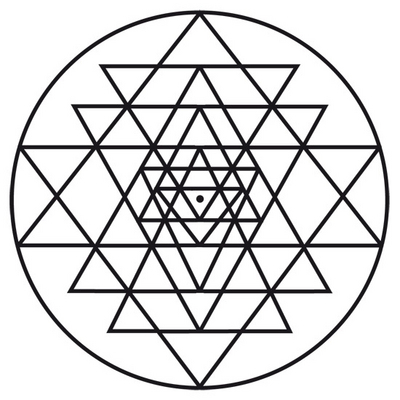
Sri Yantra

Some use the old adage others are hampered by a blockage

still more complain of the contest’s early stoppage.

It used to be about all types of suffrage

or the top quality of your package

but thankfully that unique carnage

has given way to a growing spiritual assemblage.

The great advantage of our marriage to each other

and our growing courage

is releasing us from bondage, giving us strength as the right arm

or should I say appendage

of a collective that is our right and our secret heritage.

This is not the hopeless wreckage.

It is the total package

waiting for you and I to manage our miscarriage

and unpack our baggage.

What waits for us? Only limitless advantage

and the demise of outrage as we celebrate a brand new image,

and the obsolescence of preface as we engage in this great and complex voyage

that will lead us to love and ultimately safe passage into the new frontier of a

perfect AGE

Breathe slowly and steadily…

The last “Simple Tip” (look under the categories menu tab) I shared was utilizing the complete relaxation technique.  In the systematic style of meditation expounded in the Himalayan Tradition, complete relaxation is only the second stage–it follows a postural practice.  Let’s pause for a moment– if you’re new to this blog, or yoga meditation, no worries–you don’t have to have a perfected postural (asana) practice to continue.  Furthermore, if time is a constraint, simple stretches– even a nice walk– will get you “into” the body.

Now, assuming you have worked with relaxation, which is a necessity– you cannot meditate if you are anxious and distracted— you begin to move further towards your Self via the breath.

We have all heard, anecdotally, about the importance of breathing deeply.  But, it’s more than just the decompression of a sigh– shallow breathing negatively impacts our physiology.  It is further exacerbated by, to name a few co-factors: poor posture, obesity, and incorrect breathing techniques.

In this tradition, the breath is the more “gross” manifestation of the “subtle energy” (prana) that animates the physical body– like electricity conducted along a wire. Therefore, we must refine the breath: make it deep, smooth, even (or seemless), and silent.  The key to this is diaphragmatic breathing. The following video by Swami Jnaneshvara Bharati elegantly explains the physiology of the technique.

It is important not to get frustrated if the technique feels alien at first–no one would expect us to run a marathon without training.  The upper abdominal muscles have to become stronger; furthermore, the chest and the belly have to be reeducated.

After your complete relaxation–or while you are lying on the back in savasana– you can sit tall and well and begin to work with the breath.  Take your time with it.  Keep the facial muscles and shoulders relaxed.  As I have mentioned in previous posts, less is more in the beginning.  Focus, completely, on diaphragmatic breathing for a predetermined amount of time–five to seven minutes.  You may find this metronome helpful to keeping a steady cadence; I set it to 60 bpm and then inhale for about 5 to 6 seconds and exhale for the same length.  After a while, try to lengthen the breath cycle– but, as a beginner, keep the breath even.  Then just notice the difference in your body.  What sensations do you feel?  You are laboratory and Yoga practitioners are scientist who explore themselves from the gross to the subtle– and beyond.

Shiva and Shakti

image

Thank the great mechanism for feminism
An elevator for masculinity
Conjuring the flawless interplay of non- dualism…
…So deftly propelling the organism
into the arms of divinity

Where two or three have gathered…

This week has been one of many opportunities to connect, spiritually, with many similarly minded individuals.  I travelled to my teacher’s ashram in Fort Walton Beach and participated in meditation sittings and two group discussions, I had a birthday and (experienced Facebook at it’s best) received prolific blessings from loved-ones and associates, I lead an ongoing meditation group, I participated in Unity’s World Day of Prayer, I began a new weekly meditation group, I participated in the Women of Unity meeting, and lead a workshop in the North Georgia mountains–phew!  Now, that is not a typical week; I feel as though my spiritual cup is full to the brim.  I also feel that this chance to share sacred space was a reminder of the importance of satsang–keeping company with the truth.

It is so easy to get caught up in the mundane: work, family obligation, and general busyness.  Therefore, the Himalayan Tradition recommends sitting to meditate daily– connecting with your source regularly.  When you are “plugged in” to the source, you are more inclined to remember that all that is “outside” of you is merely the “Divine Play“.

However, sharing space adds another dimension to one’s spiritual practice– above and beyond merely sharing similar ideas.  When you are with other sadhakas (aspirants), you are reminded that your center is the same as theirs.  It injects you with an optimism that there are others on this quest and reminds you, that despite all the negative images and sound bytes in the media, that there are others who are on a quest to really know themselves as well.

We all here about retreats; it is good to get away and be alone. But, propagate that energy and get together are share sacred space too!

The Gift

It is a gift to be in tune with the transcendental.

A great reward, to be so aligned.

It takes prodigious strength to be gentle and kind.

Let us commune and become instrumental

in a pervasive happiness and peace of mind.

Happy Birthday Love

To you a birthday
to me another chance
to show you a good time
another dance
another day
I can call you mine

When I hear others wish you well
and your eyes light up
and your spirits lift
I feel a sweetness clear as a bell
my cup fills up
as though I have received a gift

Thank this lovely world
for loving her as much as I do
happy to get this all so pleasantly twisted
I fell like its my day just as much as my special girl’s
with every heart beat, forever anew
historians will tell the tale, with confidence,
that a perfect love existed.

The Fortress

Do not build a fortress around what you love…
Instead build your fortress out of love–
Steadfast, impenetrable.
But, most importantly, with a large door so you can let everyone in.

Arrival

I want to give you something,
it’s a special treasure that was marked with an X on a old map I found.
It spelled out a terrain of complexity and wonder.
A vast expanse of ups and downs, bodies of water, and fantastic foliage.
A Neverland of sorts, always just beyond your feet–would certainly have to fly to get there.

We have come such a long way to find this gift.

Can you really relax?

Currently, relaxation is not our intrinsic state. Perhaps it was at birth; however, it is obscured by all of our obligations and expectations–my twelve year-old is already being told his math scores, now, may affect his collegiate endeavors… Talk about a catalyst for tension!

However, I subscribe to the idea that our stress response depends on our perspective. I believe, as do many other renowned professionals that we can shift our relationship with stress through regular practice. The reality is that “relaxation is a skill unto itself” (Swami Jnaneshvara Bharati). What does that mean? Relaxation is a skill. Let me elaborate.

It starts with the body; the problem is we aren’t really in our bodies. We can’t relax while we are disconnected. Do you feel your fingers pressing on your tablet, do you feel your foot on the gas pedal? We are outside in the world of the senses, stimulation, and flux. Our stress reaction partially comes from being “outside” of our true center which is not subject to change, corruption, and decay.

In this tradition, the physical body is not viewed as something other than the self– it is viewed as a layer that has its origins in the eternal.  Therefore, the physical body needn’t be deprived by extreme measures–nor inundated with sensuality.  The physical body must become a participant on the inward journey.

Pratyahara, sense withdrawal, is the process of disengaging ourselves from our sensory experience.  We move from being outside in our experience to being in our own body.  Hence the need to dim he lights and seek a quiet place to relax or meditate.  Using music or “white noise” is still stimulation– this is using an extrinsic source to “feel” relaxed.  Ultimately, relaxation must come from within.

Postural practice (yoga poses), asana, can assist with getting “in” the body.  However, many practitioners feel that this is the apical experience of yoga– it’s only a preliminary one. After asana practice, the body is prepared for profound relaxation– this relaxation is essential to deep, sustained meditation.

Complete Relaxation is a beautiful way to work on entering into this state.  It is an approach of moving through the body and not ignoring it.  It is a beautiful finale to a postural practice. It can be practiced alone or in preparation to a seated practice.  For a beginner, it is a way to increase your time in stillness– while satisfying the need to have a little stimulation.

This seems like a paradox; relaxing to meditate. It isn’t so antithetical– imagine trying to sit and meditate if you’re agitated and distracted. Once you are able to establish a relaxed state, a regular meditation practice reduces this inclination toward a negative stress response.